How to launch a blockchain business in Dubai 2026: 12 steps to navigate regulations and thrive
How to launch a blockchain business in Dubai 2026: 12 steps to navigate regulations and thrive
Master Dubai's blockchain ecosystem with insights on DET approvals, VARA licensing, secure tech stacks, business plans, and growth strategies in DMCC and ADGM free zones.
Vincy Amirtharaj
58 post
Senior Business Setup Consultant, Dubai
Dubai has placed transparency, efficiency and automation at the forefront while building a digital future. The launch of the futuristic Dubai Metaverse Strategy and well-defined licensing framework for virtual asset activities under Virtual Assets Regulatory Authority (VARA) are some of the Emirate’s transformative steps toward becoming the global capital for Web3 innovation. A major part of this transformation lies in the increased focus on blockchain development in the UAE. The Emirate of Dubai is now a fully recognized global leader in blockchain adoption. Entrepreneurs can find answers to how to start a blockchain business in Dubai by exploring the thriving ecosystem that offers zero personal income tax, 100% foreign ownership and world-class infrastructure designed specifically for digital asset enterprises.
Getting a blockchain licence in Dubai falls under a transparent and regulated process. Tailored licensing frameworks are offered by specialized hubs like the DMCC Crypto Centre and Dubai World Trade Centre (DWTC) if your plan is to launch a centralized exchange (CEX), an NFT marketplace or a blockchain consultancy. This regulatory clarity protects investors and improves banking confidence in blockchain-based ventures.
Needless to say, a comprehensive approach to blockchain company formation in Dubai will put you on a strong footing in 2026. All the information you will need to select the right jurisdiction and understand the exact blockchain business setup cost is neatly structured throughout this guide. We have explained all the steps from securing the right commercial licence to obtaining the necessary approvals and everything in between to make your blockchain business ready for scaling in the heart of the Middle East's digital economy.
Typical 8-10 week setup timeline
Week
Authority / Task
Key output
1
Free Zone / DET
Initial approval ✓ | Trade Name Reservation ✓
2
Management
Whitepaper drafting & Business Plan finalization
3
VARA / Free Zone
Initial Disclosure Questionnaire (IDQ) submission
4
Registrar
Commercial License issued (Non-Operational) ✓
5
VARA
Provisional Permit / MVP License Application
6
Bank
KYC review (Wio / Traditional) → Account approval
7
GDRFA
Investor / Team visas stamped
8+
VARA & Auditor
Full Market Product (FMP) approval - Go live!
Note: Non-regulated activities (e.g., blockchain consultancy) can launch in 2 weeks. Regulated activities (Exchanges/Custody) require full VARA scrutiny taking 3-4 months.
"Dubai will become one of the world’s top 10 metaverse economies as well as a global hub for the metaverse community."
- HH Sheikh Hamdan bin Mohammed bin Rashid Al Maktoum
Select the activity that matches your tech stack. This determines if you need a Full VARA License or just a standard commercial license:
Virtual Asset Exchange
Centralized trading platforms (CEX) & brokerage.
Metaverse Service Provider
Developing virtual worlds, digital twins, and assets.
NFT Marketplace
Platforms for minting and trading non-fungible tokens.
Blockchain Consultancy
Advisory on tokenomics, smart contracts & tech (Non-regulated).
Custody Services
Safekeeping of digital assets and wallet management.
Proprietary Trading
Trading own funds in crypto (No third-party funds).
Software Development
Coding DApps, protocols, and blockchain infrastructure.
Pro tip
Clarify whether you handle third-party funds (Exchange/Broker) or just code software. Handling client funds triggers mandatory VARA Full Market Product licensing.
Step 2: Choose a trade name
To set up your business in Dubai successfully, your chosen name must meet the Department of Economy and Tourism (DET) guidelines.
Pick a unique, future-proof name. Ensure your trade name doesn't infringe on existing global token tickers ($BTC, $ETH). Secure the matching .ae or .io domain—VARA requires a live digital presence for approval.
Quick Fact
The DMCC Crypto Centre is now home to over 600 registered crypto businesses, making it the highest concentration of Web3 firms in the MENA region.
Source: DMCC
Step 3: Draft a VARA-compliant business plan
Whitepaper & Tokenomics
Utility of the token, vesting schedules, and minting logic.
Screening tools (e.g., Chainalysis) and compliance officer hire.
Pro tip
Capital Adequacy: Regulated entities (e.g., Exchanges) must prove significant paid-up capital (often >AED 1M) to VARA. Consultancy firms have no such requirement.
Cost snapshot · 2026
Paid-up Capital: AED 0 - 1M+ (depends on activity)
DED initial approval: ~AED 120
Trade-name reservation: AED 620
DMCC Crypto Licence package: ~AED 49 000
IFZA Tech Consultancy package: from AED 12 900 (0-visa)
VARA Application Fee: from AED 40 000 - 100 000*
Tech & Security Audit: Varies by provider
*VARA fees vary significantly based on activity (Advisory vs. Exchange).
Setup-cost estimator (AED)
Estimated setup cost: —
Get detailed breakdown on WhatsApp
*Includes AED 740 for initial approval (120) + trade-name reservation (620).
VARA application fees and paid-up capital are excluded.
Step 4: Select a business structure
Pick the corporate vehicle that fits your liability appetite and token governance model:
FZ-LLC (Free Zone)
Most common for crypto startups. 100% foreign ownership within DMCC, IFZA, or DWC.
Mainland LLC
Required if you intend to open a physical crypto-OTC counter or retail office.
Foundation (DIFC/ADGM)
Ideal for DAOs and holding IP/Treasury. No shareholders, only beneficiaries.
Branch Office
Extend an existing regulated foreign exchange (e.g., from Singapore or UK) to Dubai.
Pro tip
DAOs are not legally recognized as entities in mainland Dubai. Most Web3 founders wrap their DAO in a Foundation structure to sign contracts and hire staff.
Don’t just get licensed—get operationally ready
Retyn provides the technological backbone you need to go live, including our proprietary LaunchPad for milestone tracking and GuardRails for automated compliance.
This is the most critical decision. Dubai has two distinct regulatory environments for crypto:
VARA jurisdiction (Mainland, DMCC, DWTC)
Governed by the Virtual Assets Regulatory Authority (VARA). This is the standard for 90% of crypto businesses in Dubai.
Ideal for Exchanges, Broker-Dealers, and Wallet Services targeting the wider UAE market. Entrepreneurs starting a company in free zone areas often benefit from industry-specific ecosystems and streamlined customs. However, if your business model requires deep integration with the onshore domestic economy, starting a company in Dubai mainland is usually the more robust long-term choice.
Key Hubs:
DMCC Crypto Centre
Home to Binance & Bybit. Offers a supportive ecosystem and co-working labs.
DWTC (Dubai World Trade Centre)
Another VARA-compliant free zone with strong proximity to events.
Mainland Dubai
For retail-facing businesses requiring street-level visibility.
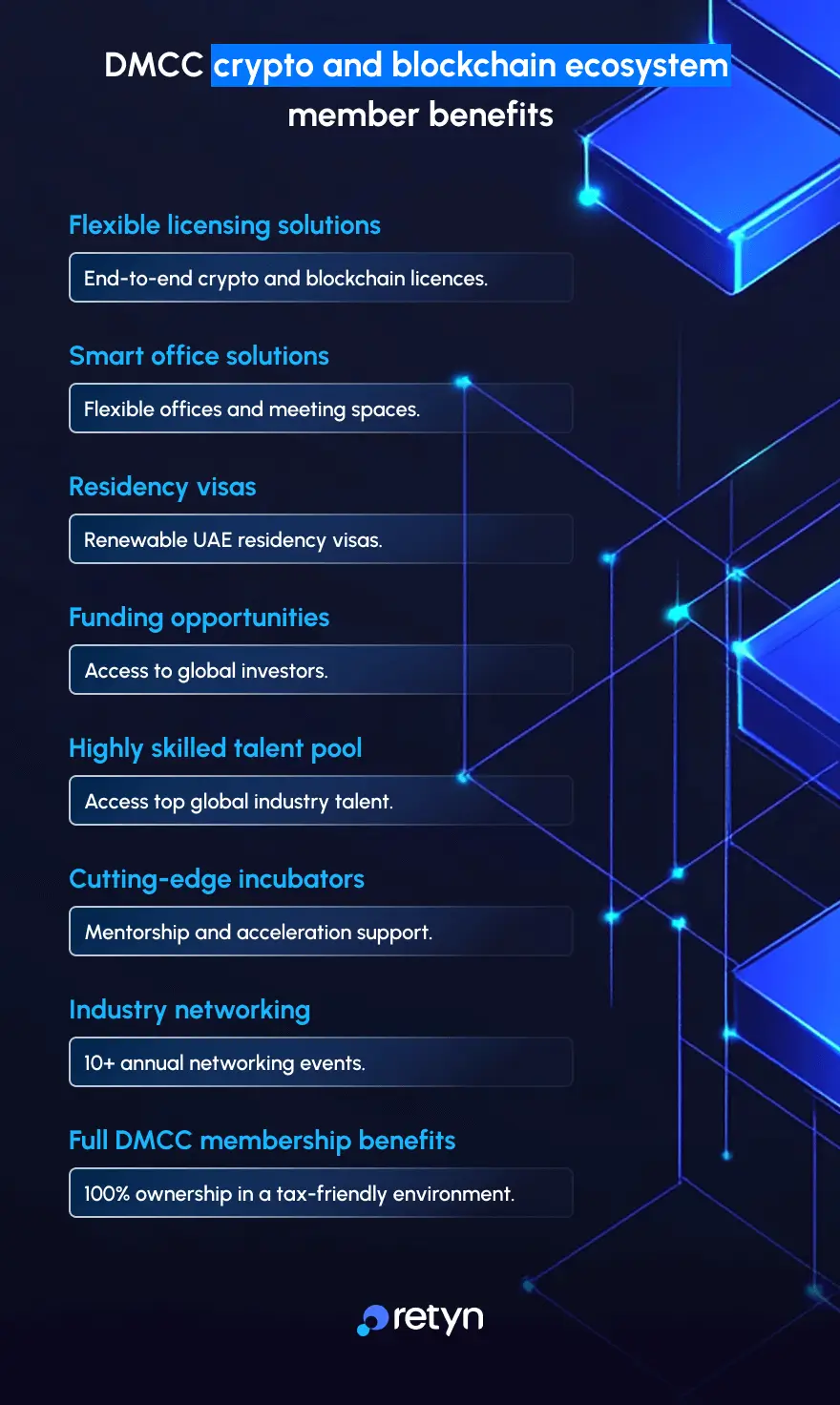
While DMCC offers a mature crypto ecosystem, licensing is subject to specific regulatory and operational conditions. Review the DMCC crypto licensing checklist to ensure your structure aligns with VARA and free-zone expectations.
DIFC (Financial Free Zone)
A "Common Law" jurisdiction with its own regulator (DFSA). Totally separate from VARA.
Best for institutional finance, hedge funds, and investment banks moving into digital assets.
Ideal for:
DIFC Innovation Hub
Accelerator programs for institutional-grade FinTech.
Tokenized Funds
Asset managers issuing security tokens.
Family Offices
Managing private crypto wealth under English Common Law.
Quick Fact
UAE ranks fifth globally in crypto adoption, joining the ranks of major institutional hubs such as Singapore, the United States, Lithuania, and Switzerland.
Source: World Crypto Rankings 2025
Step 6: Register & obtain your crypto license
This is a multi-stage process involving both your commercial registrar (e.g., DMCC) and the regulator (VARA).
Phase 1: Commercial registration
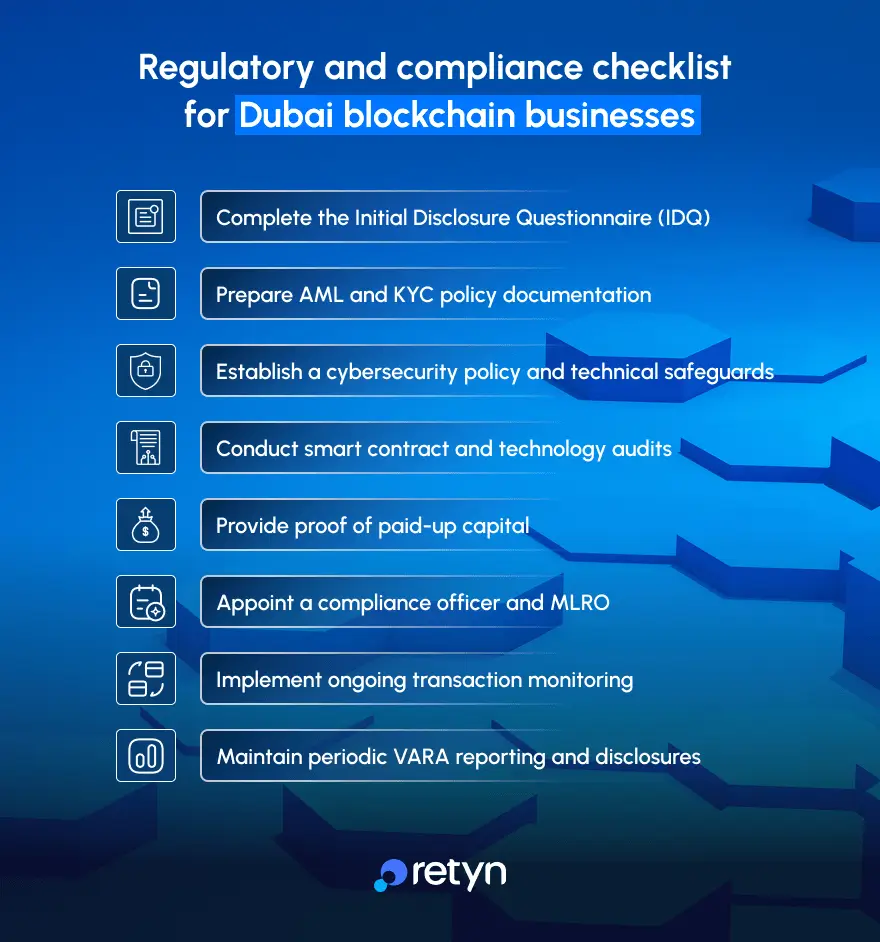
Initial Disclosure Questionnaire (IDQ)
Submit your business model to VARA to categorize your activity.
Initial Approval
Free Zone issues initial approval based on VARA's "No Objection".
License Issuance (Non-Operational)
You receive a trade license, but it will state "Subject to VARA FMP Approval". You cannot trade yet.
Phase 2: VARA FMP licensing
MVP / FMP Application
Submit detailed policies: AML, Cybersecurity, Custody, and Marketing.
Technology Audit
Third-party audit of your smart contracts and wallet infrastructure.
Go-Live Approval
VARA issues the final permit. You can now onboard customers and process transactions.
Licence-application document checklist
Shareholders & Directors
Passport & UAE entry stamp (all UBOs)
Professional CV / LinkedIn Profile (VARA "Fit & Proper" test)
Police Clearance Certificate (from home country)
Bank Reference Letter
Emirates ID (if resident)
Utility Bill (Proof of address)
Entity & Technology
Comprehensive Business Plan
Whitepaper (for token projects)
AML / CFT Policy Manual
IT & Wallet Architecture Diagram
Initial Disclosure Questionnaire (IDQ) copy
Proof of Capital (if regulated activity)
Tip: For regulated activities, VARA requires a "Compliance Officer" and "MLRO" to be appointed prior to final approval.
sequenceDiagram
participant Founder
participant FZ as Free Zone / Registrar
participant VARA
participant Bank
participant GDRFA
Founder->>VARA: 1 · Submit IDQ (Initial Disclosure)
VARA->>FZ: 2 · Issue NOC for Incorporation
FZ-->>Founder: 3 · Commercial License (Non-Operational)
Founder->>GDRFA: 4 · Immigration & Visas
GDRFA-->>Founder: Visas stamped
Founder->>Bank: 5 · Open Operational Account
Bank-->>Founder: Account Active (Opex only)
Founder->>VARA: 6 · Submit FMP Application
VARA->>Founder: 7 · Tech & Compliance Audit
VARA-->>Founder: 8 · Final Approval (Go Live!)
Note over Founder: 9 · Ongoing Reporting (AML/Transaction monitoring)
Obtain your establishment card and complete visa processing in Dubai in line with GDRFA procedures. Dubai offers specialized Golden Visas (10 years) for exceptional coding talent and digital investors.
Pro tip
Remote work is common in Web3. Ensure your "Remote" staff policies align with UAE Labour Law (MOHRE) regarding data privacy and IP ownership.
Step 8: Open a crypto-friendly bank account
This is historically the hardest step. You must segregate "Client Funds" (custody) from "Operational Funds" (rent/salaries). Digital banks like Wio are increasingly crypto-friendly for opex accounts.
Trade Licence
Your Non-operational license is sufficient for Opex accounts.
Source of Funds
Clear evidence of where initial seed capital originated (VC, personal savings).
Client Money Accounts
Required for Exchanges. Only tier-1 banks (e.g., FAB, ENBD) usually offer this.
Website & corporate email
Banks check your site for consistency with your license activity.
Physical Presence
Flexi-desks are accepted, but a physical office aids approval.
Beyond VARA, specific Web3 activities may trigger other regulators:
Central Bank (CBUAE)
Required if you offer fiat-payment gateways or Stored Value Facilities (SVF).
SCA (Securities Authority)
Required if your token is classified as a "Security" rather than a utility.
TDRA
For importing specialized hardware (e.g., Bitcoin Mining Rigs).
Note: Mining crypto is permitted but requires industrial-zone placement (e.g., JAFZA) due to high electricity loads.
Step 10: Arrange Web3 insurance
Insurance planning is a regulatory requirement within the process involved in starting a business in Dubai. VARA requires regulated entities to maintain adequate insurance coverage relative to their AUM (Assets Under Management).
Step 11: Stay compliant—VARA & AML reporting
Log these recurring tasks to avoid license suspension:
License Renewal
Annual commercial fee & VARA supervision fee.
VARA Marketing Guidelines
Pre-approval required for any mass-media crypto ads in Dubai.
UBO & Corporate Tax
9% Tax applies unless you meet "Qualifying Income" criteria in Free Zones.
FATF Travel Rule
Mandatory reporting of sender/receiver info for crypto transfers > AED 3,500.
Wallet Screening
Ongoing sanctions screening of all client wallet addresses.
Pro tip
Use a compliance calendar to track VARA audit submissions, license renewals, and Monthly Transaction Reports.
Free 2026 Crypto-Compliance Calendar (Excel)
Never miss a VARA filing, VAT deadline, or AML audit again. Tap below and we'll WhatsApp the Excel sheet instantly.
If you are deploying your own token or protocol, VARA requires evidence that your code is secure. You must engage with approved technical auditors:
Smart Contract Audit
To prevent re-entrancy attacks and logic bugs (e.g., Certik, Hacken).
Penetration Testing
Stress-testing your exchange or dApp interface against hacks.
Custody Audit
Proof of Reserves (PoR) verification for custodial wallets.
Pro tip
Maintain a "living" GitHub repository for your project. VARA auditors may review commit history to ensure no malicious code was injected post-audit.
Expert insight: The rise of RWA and Institutional DeFi in Dubai
Blockchain narrative in Dubai has entered a new phase, moving away from retail speculation toward institutional utility. For the years from 2026 onward, the biggest opportunities lie in Real World Asset (RWA) tokenization and the integration of regulated DeFi protocols. This shift has pushed attention away from simple token launches. Founders now build infrastructure that bridges traditional finance (TradFi) with Web3 that are being overseen by regulators like VARA and the DFSA.
Investors and venture capitalists in the region are now eyeing for those projects that give tangible economic value. The below mentioned five strategic pillars can help new licence holders get access to high-value partnerships and receive necessary regulatory approvals in this maturing market.
Tokenizing Real-World Assets (RWA)
The Emirate of Dubai is turning into a global testbed for tokenizing tangible assets, including real estate, gold and Sukuks. It attracts a slew of asset managers with the promise of operational gains and quicker settlement times.
Regulatory oversight for RWA token issuances has now officially been placed within VARA’s regulatory jurisdiction. As a result, RWA token issuances are no longer in a regulatory gray area. Version 2.0 of VARA’s activity-based rulebooks provides an overarching legal framework for Asset Referenced Virtual Assets (ARVAs), including fractional ownership of high-value assets and access to global liquidity pools.
Institutional-Grade DeFi
DeFi protocols in Dubai mandate Virtual Asset Service Providers (VASPs) to meet anti-money laundering (AML) and counter-terrorism financing (CFT) requirements.
You may onboard institutional capital from local family offices and banks that are restricted from unregulated markets by building compliant liquidity pools.
The Metaverse Economy
Government entities collaborate with international technology companies, entrepreneurs and startups specialized in the metaverse world as part of the Dubai Metaverse Strategy.
Startups that focus on and develop "Digital Twin" technology for vital sectors such as tourism, urban planning, education, healthcare and the legal sector can tick all the boxes of the strategy's key focuses. Utilize accelerator and incubator programs in the UAE that support advanced metaverse ecosystems.
Green Blockchain & ESG
Initiatives like UAE’s Net Zero 2050 commitment points out the demand for more efficient consensus mechanisms as blockchain space advances in the UAE. The major shortcomings of energy-intensive Proof of Work (PoW) mining are being addressed through alternative consensus mechanisms.
Projects that adopt Proof of Stake (PoS) or those that deploy carbon-credit tokenization might take better advantage of banking access and industrial power rates.
Qualified Custody (MPC Tech)
The Emirate is now seeing an increase in interest shown in self-custody infrastructure and Multi-Party Computation (MPC) wallets.
Add a layer of credibility with well-regulated and insurance-backed digital asset custody services in the UAE. This elevates trust for high-net-worth individuals (HNWIs) who are moving their wealth into the region.
Pro tip
Include a dedicated "Regulatory Roadmap" section in your whitepaper. VARA auditors look for a clear understanding of when you will transition from an MVP license to a Full Market Product (FMP) license.
Decision snapshot – what to choose, at a glance
Structure / License
Regulator
Bank Account Ease**
Setup Speed
Cost
Best For
DMCC Crypto Centre
VARA
High
≈ 4-8 weeks
$$$
Prop Trading / Exchanges
IFZA (Consultancy)
Non-Regulated
Medium
5-10 days
$
Dev Shops / Marketing
DIFC Innovation Hub
DFSA
High
3-6 months
$$$$
Institutional Funds
Mainland (VARA)
VARA
Medium
≈ 8 weeks
$$$
Retail Crypto Counters
Offshore Foundation
None
Low
2 weeks
$$
DAOs / IP Holding
** "Bank-account ease" depends heavily on your AML policy quality. Non-regulated consultancy firms open accounts faster than Exchanges.
Risk & penalty matrix – key non-compliance fines
Offence
Fine (AED)
Consequence
Marketing crypto without VARA Approval
20k - 500k
Website block & License freeze
Operating an Exchange without FMP License
Up to 500k
Immediate closure & Blacklisting
Failure to report Suspicious Transactions (STR)
50k +
Criminal liability for directors
Figures are based on VARA's enforcement guidelines. Always check the latest rulebooks.
Applying for a license before checking if your token is a security (SCA jurisdiction).
Assuming a "Consultancy" license allows you to trade client funds (it doesn't).
Using a personal bank account for business crypto trades (guaranteed account freeze).
Marketing to UAE residents without a local VARA license (even if you are licensed offshore).
Regulation & News updates · Q4 2025
VARA Marketing Regulations Update:
All "Virtual Asset Service Providers" (VASPs) must include a prominent risk warning disclaimer in all ads targeting Dubai residents.
UAE Corporate Tax on Crypto:
Clarification issued: Trading own crypto (prop trading) may be exempt if structured correctly in a Free Zone ("Qualifying Income"), but fees from exchange services are taxable at 9%.
Stablecoin Framework:
Central Bank of UAE (CBUAE) has released new guidelines for issuing Dirham-backed stablecoins.
AML/CFT - Anti-Money Laundering / Combating Financing of Terrorism
UBO - Ultimate Beneficial Owner
FAQs on starting a blockchain business in Dubai
The time frame to obtain a regulated VARA licence can range between six to twelve (6-12) months depending upon the complexity of your business model, the completeness of your documentation and the regulatory review process. Alternatively, blockchain consultancy services or software development activities may be provided under a standard Dubai free zone commercial licence that can usually be issued in just a few weeks.
In the past, opening a corporate bank account for a blockchain firm was challenging. However, in 2026 many digital banking platforms such as Wio and progressive traditional banks such as Mashreq and Zand have made significant progress and can now onboard blockchain firms. When onboarding a blockchain entity into a bank, they will be required to demonstrate a well-defined AML/CFT compliance plan and assurance that client funds are kept separate from the company’s operational funds.
No, you do not have to pay 9% corporate tax on every single one of your blockchain profits. Blockchain businesses operating in the UAE are subject to a 9% corporate tax on their net profits when they exceed AED 375,000. But if you register your business in a free zone like DMCC or DIFC, you may be able to earn a 0% corporate tax rate on your qualifying activity income. Any income generated by a free zone business that comes from non-qualifying activities (like service charges or exchange commissions earned from mainland UAE clients), will probably be subject to the 9% corporate tax rate.
This will depend on the nature of your business.
Flexi-desks or virtual offices are usually acceptable for non-regulated businesses (for example, blockchain consultancy or software development) and most Dubai free zones permit this arrangement with the issuance of a standard commercial licence.
Companies operating under regulated categories such as virtual asset exchanges, custody providers and broker-dealers are required to have a physical office in Dubai. In addition, VARA requires that companies maintain "economic substance", in part by keeping an actual office to manage day-to-day operations and compliance. Therefore, a company cannot operate with a flexi-desk or virtual office when they are providing a regulated service.
Yes. Under Virtual Asset Issuance framework, token launches in Dubai are governed by applicable virtual asset regulations. As such, tokens require regulatory approval prior to launch. The issuer is required to develop a compliant whitepaper that meets the required disclosure standards. In many cases, the issuer will also need to obtain a legal opinion on how the token should be classified and have the smart contract code reviewed or audited by a technical reviewer to ensure compliance with approved market practices.
The FATF Travel Rule is mandatory for Dubai. As a VASP (Virtual Asset Service Provider) you will need to collect and send the personal details of both the sender and the beneficiary to the receiving institution when the transfer exceeds AED 3,500.
Yes, you can. Dubai has an open arms policy for foreign talent through the Golden Visa for Coders. You can also provide visas for talent from around the globe. In addition, there are remote work permits that enable you to lawfully employ workers even though they may not be physically working at your office on a daily basis.
Disclaimer: This content is for information only and not legal advice. Crypto regulations in Dubai change rapidly—always consult a qualified corporate services provider or lawyer.
Need help navigating VARA licensing?
Book a free consultation with our Web3 setup experts.